
Understanding SBIR
The Small Business Innovation Research (SBIR) program is a structured federal funding mechanism that requires agencies with extramural research budgets above $100 million to set aside a percentage for small business awards. For medical and biotech companies, the most relevant SBIR funders are the National Institutes of Health (NIH), the Department of Defense (DoD), and the National Science Foundation (NSF).
SBIR is designed to support the commercialization of federally funded research. The program’s three-phase structure is intentionally staged: Phase I validates technical feasibility (typically $150K–$300K), Phase II funds full R&D development (up to $2M), and Phase III bridges to commercialization using non-SBIR funds — often through contracts, partnerships, or private investment.
For medical device, diagnostics, and therapeutics companies, NIH SBIR is particularly relevant. NIH’s National Center for Advancing Translational Sciences (NCATS) and the National Cancer Institute (NCI) maintain active SBIR portfolios that fund early-stage clinical translation. FDA regulatory strategy and evidence of clinical need are weighted evaluation criteria alongside scientific merit.
How DARPA Approaches Medical Innovation
DARPA’s Biological Technologies Office (BTO) funds research at the intersection of biology, engineering, and national security. Unlike SBIR’s commercial translation focus, DARPA targets capabilities that would be impossible within current scientific paradigms. BTO programs have included breakthroughs in traumatic injury treatment, synthetic biology, neurotechnology, and pandemic preparedness.
DARPA does not follow the SBIR set-aside structure. Awards are made through Broad Agency Announcements (BAAs), Other Transaction Authority (OTA) agreements, and direct contracts. There is no Phase I/II structure — DARPA programs are defined by technical milestones set by program managers, who hold significant authority to redirect, expand, or terminate programs based on progress.
For medical and biotech companies, DARPA engagement requires demonstrated capability in high-risk research, credible scientific leadership, and alignment with specific BTO program objectives. The barrier to entry is higher than SBIR, but successful engagement can yield transformational funding and position a company as a recognized leader in its domain.
Structural Comparison
The table below summarizes the key structural differences between SBIR and DARPA funding for medical and biotech organizations.
| Dimension | SBIR | DARPA |
|---|---|---|
| Eligibility | Small businesses only (<500 employees, US-owned) | Open to all — small businesses, universities, large primes |
| Funding size | Phase I: $150K–$300K; Phase II: up to $2M | $500K seedlings to $50M+ multi-year programs |
| Program structure | Phased (I → II → III), milestone-driven | Program-defined milestones, PM discretion |
| Review process | Formal peer review panels, scored criteria | PM-led technical evaluation, white paper screening |
| Timeline predictability | High — defined solicitation cycles | Low — BAAs open-ended, PM-dependent |
| IP ownership | Awardee retains IP; limited government license | Negotiated; OTA agreements vary |
| Commercialization focus | Explicit requirement; scored in evaluation | Not required; mission capability is primary |
| Risk tolerance | Moderate — feasibility must be credible | Very high — failure is acceptable if ambitious |
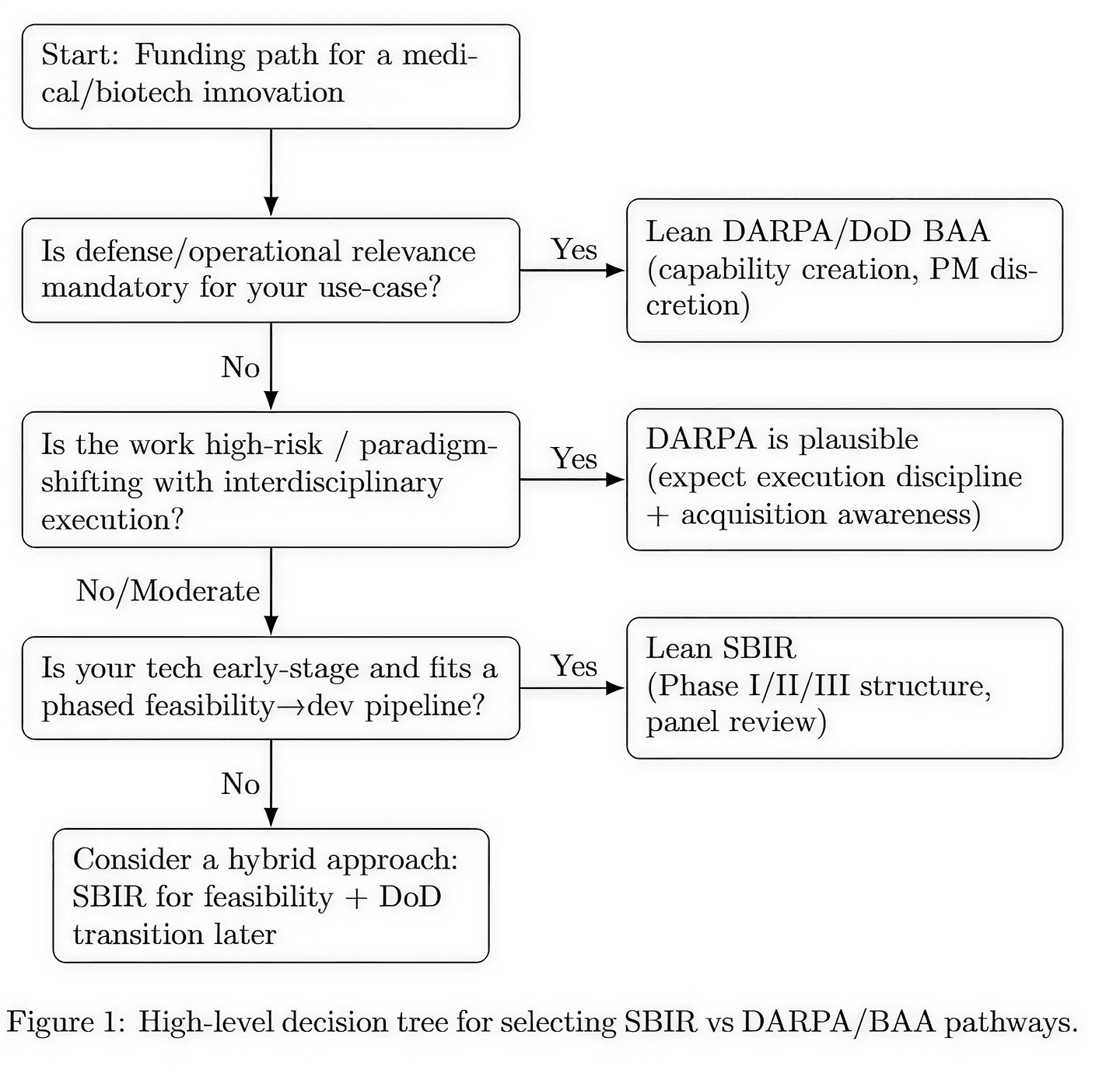
Which Path Is Better?
The answer depends on four variables: technology readiness level (TRL), team experience with government contracting, organizational risk tolerance, and the nature of the innovation itself.
Choose SBIR if: your medical or biotech technology is at TRL 2–5, your primary end-market is commercial with government as a secondary customer, your team has limited prior government contracting experience, or you need predictable cash flow to sustain operations through the development cycle.
Choose DARPA if: your technology represents a genuine paradigm shift in medical capability, your founding team includes recognized domain experts with prior federal research relationships, your innovation horizon is 7–15 years, or your technology has direct national security implications (biodefense, warfighter health, field medicine).
The most sophisticated medical and biotech companies pursue both simultaneously — using SBIR to build foundational capabilities and a contracting track record, while cultivating DARPA program manager relationships for transformational opportunities.
Common Failure Modes
Medical and biotech companies most frequently fail in federal funding pursuits for the following reasons:
- Misaligned topic selection: Applying to SBIR topics that don’t align with the agency’s current mission priorities, regardless of scientific merit.
- Weak commercialization sections: NIH SBIR evaluators weight commercialization heavily; technically excellent proposals with thin market analysis are routinely scored lower.
- Underestimating DARPA’s people focus: DARPA funds teams as much as technologies. Proposals without credible, named PI leadership rarely advance.
- No prior engagement: Submitting to a DARPA BAA without prior white paper dialogue with the relevant PM is a significant disadvantage.
- Regulatory blind spots: Medical device and therapeutic SBIR proposals that ignore FDA regulatory pathway requirements signal naivety to reviewers.
How fed.net Advises Medical & Biotech Clients
fed.net approaches federal funding strategy for medical and biotech companies as a multi-year positioning exercise, not a one-time proposal event. Our process begins with a technology readiness and agency alignment assessment — mapping your innovation against active SBIR solicitations and open DARPA BAAs to identify the highest-probability near-term targets.
For SBIR pursuit, we develop proposal narratives that integrate scientific rigor with explicit commercialization strategy, regulatory pathway clarity, and team qualification evidence. For DARPA engagement, we support white paper development, PM outreach strategy, and full proposal drafting aligned with BTO program objectives.
We also help clients build the organizational infrastructure required to manage federal awards — including accounting systems compliant with DCAA audit requirements, intellectual property protection frameworks, and subcontract management for university partnerships.
Final Thoughts
SBIR and DARPA represent the two most consequential federal funding pathways for medical and biotech innovation. SBIR offers structured, accessible funding with explicit commercialization alignment. DARPA offers transformational funding for paradigm-shifting capabilities with higher risk and higher reward.
Understanding which mechanism fits your technology, your team, and your timeline is the first step toward a sustainable federal revenue strategy. The companies that consistently win federal funding — and build lasting government relationships — are those that invest in proposal quality, agency engagement, and long-term positioning with the same discipline they apply to their science.