
Overview
For biotech startups operating at the frontier of science and national security, two federal funding mechanisms stand apart: the Small Business Innovation Research (SBIR) program and the Defense Advanced Research Projects Agency (DARPA). Each offers distinct advantages, timelines, and strategic implications. Understanding which path aligns with your technology and organizational stage is essential for maximizing both funding success and long-term positioning.
This article provides a structured comparison of SBIR and DARPA funding paths, examining their programmatic logic, proposal requirements, and the strategic factors that should guide a biotech startup’s decision.
The SBIR Program: Structured Innovation at Scale
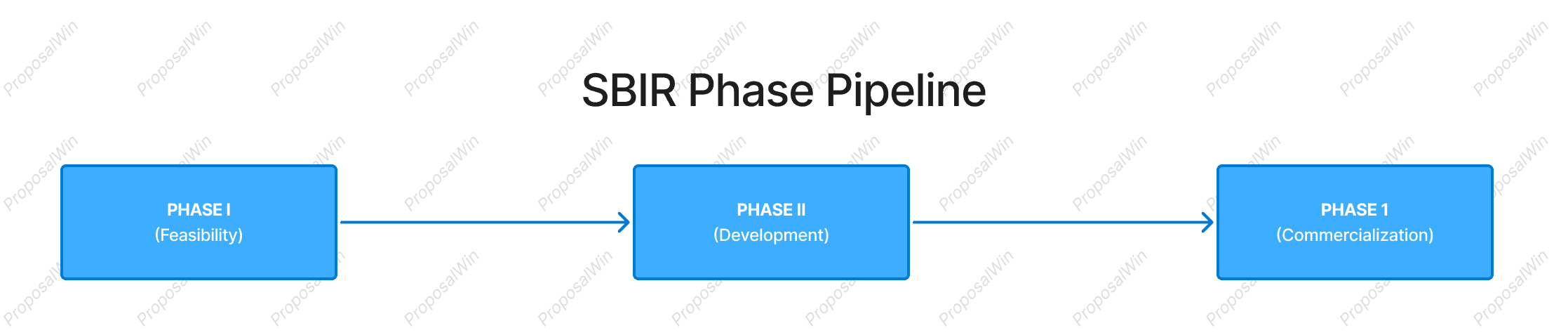
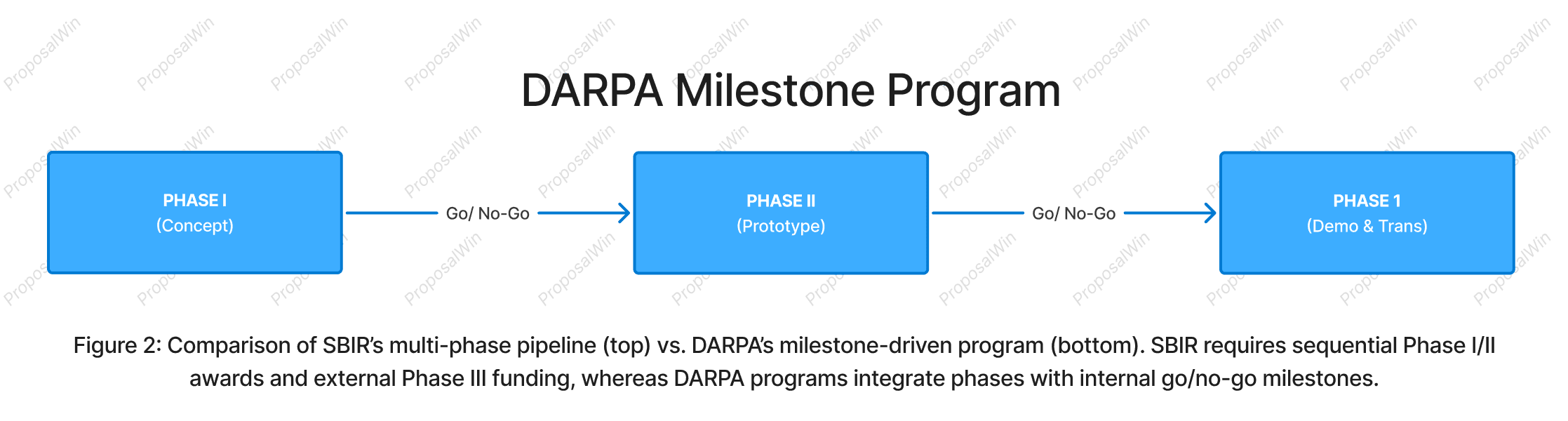
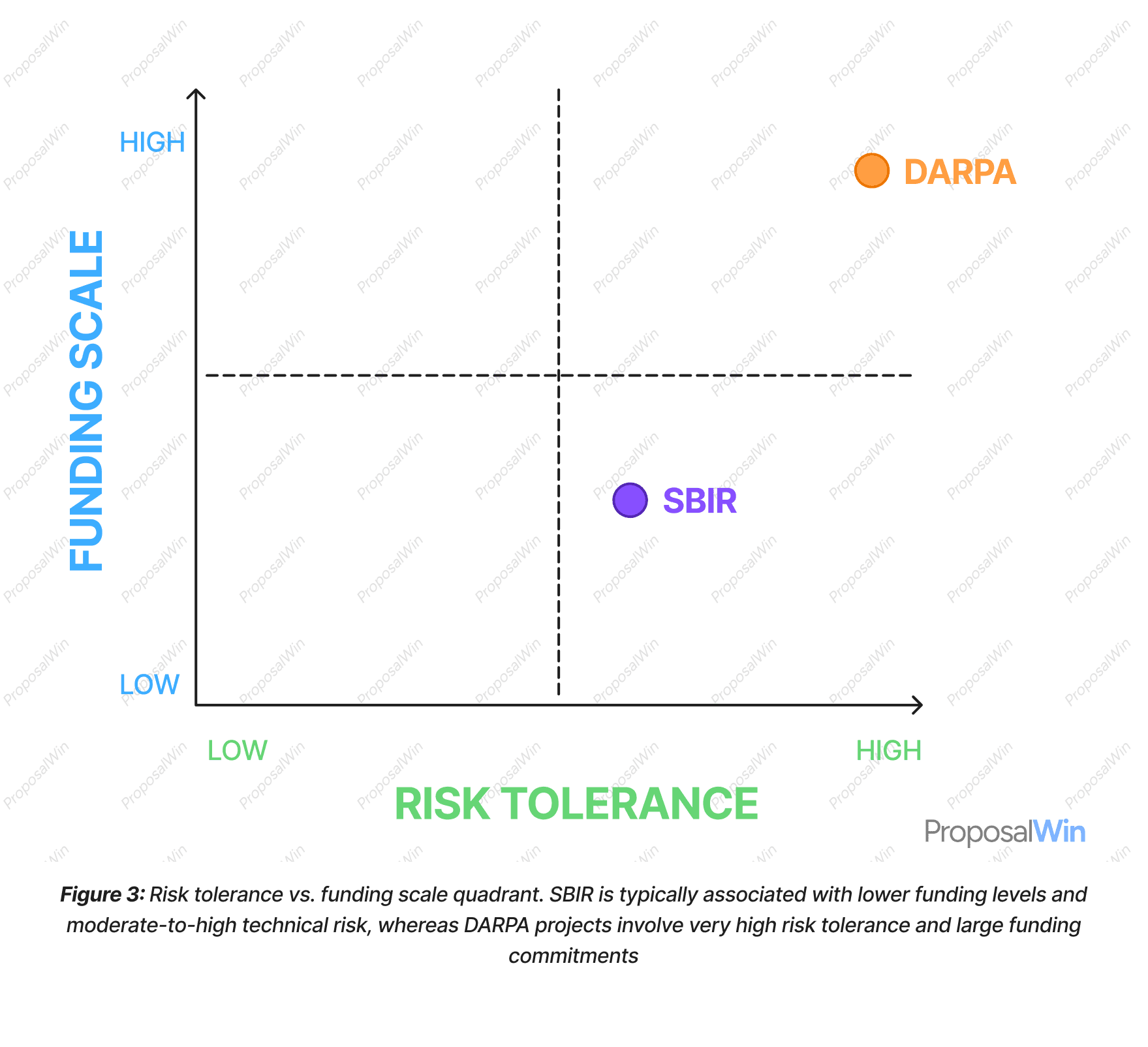
SBIR is a congressionally mandated set-aside program across 11 federal agencies, designed to engage small businesses in federally funded R&D with the potential for commercialization. The program operates in three phases: Phase I (feasibility, typically $150K–$300K over 6 months), Phase II (full R&D, up to $1M–$2M over 24 months), and Phase III (commercialization, non-SBIR funded).
For biotech startups, SBIR’s primary attraction is its structured, milestone-driven funding model. Agencies including NIH, DoD, and NSF offer topic-specific solicitations that allow startups to align research focus with agency mission priorities. SBIR also offers a lower barrier to entry compared to DARPA, with evaluation criteria emphasizing scientific merit, commercialization potential, and team qualifications.
DARPA: High-Risk, High-Payoff Science
DARPA operates under a fundamentally different philosophy. Rather than supporting incremental innovation, DARPA funds transformational research that, if successful, would create entirely new technological capabilities. DARPA program managers (PMs) have broad discretion to fund approaches they believe could achieve breakthrough outcomes — often bypassing traditional peer review in favor of direct technical engagement.
DARPA’s Biological Technologies Office (BTO) has become increasingly active in funding biotech innovations relevant to warfighter health, synthetic biology, and biodefense. Funding mechanisms include BAAs (Broad Agency Announcements), seedling grants, and direct contracts. Award sizes vary widely — from $500K seedlings to $50M+ multi-year programs.
The critical differentiator: DARPA funds ideas and people, not just technically sound proposals. A compelling technical vision and a credible PI or founding team can outweigh a polished proposal format.
Proposal Requirements: Where the Paths Diverge
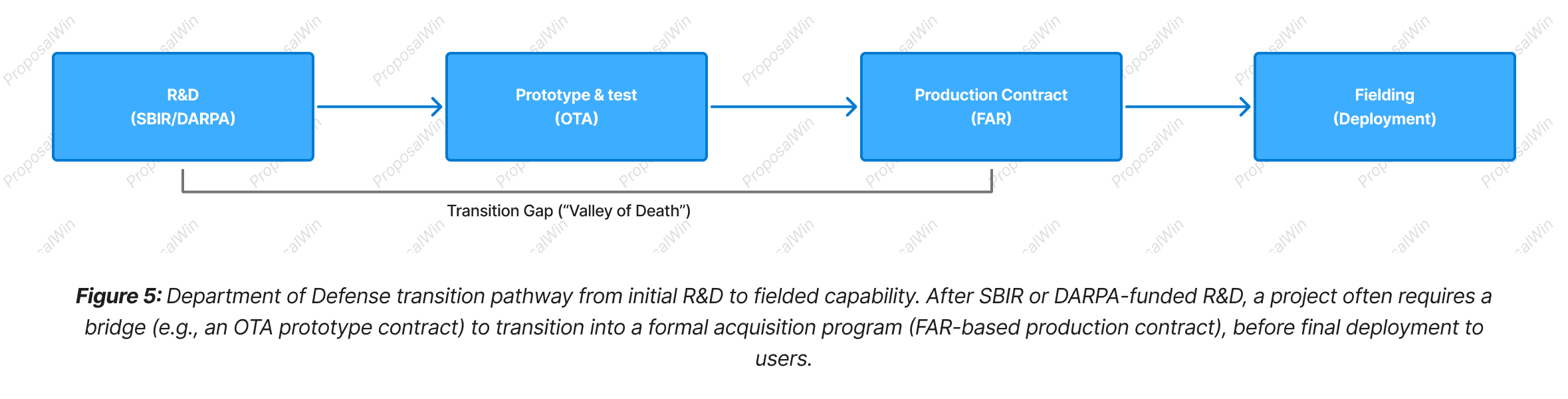
SBIR proposals follow standardized templates defined by each agency, with explicit sections for specific aims, technical approach, innovation, commercialization strategy, and team qualifications. NIH SBIR proposals require a detailed commercialization plan and evidence of market need. DoD SBIR proposals may emphasize transition potential to programs of record.
DARPA proposals — typically submitted in response to BAAs — are less structured but more demanding in their conceptual ambition. A typical DARPA proposal must articulate a bold technical vision, explain why the current state-of-the-art is insufficient, identify measurable milestones, and demonstrate a team capable of executing against long-odds objectives. Executive summaries and white papers are often used as initial screening mechanisms before full proposals are requested.
For biotech startups new to federal contracting, SBIR’s structured format is significantly more accessible. DARPA’s open-ended requirements reward scientific creativity but penalize organizations without prior government research experience.
Timeline and Risk Profile
SBIR operates on predictable cycles. Agency solicitations are published on schedules (often annually or semi-annually), and award timelines typically range from 3–9 months post-submission. This predictability allows startups to plan resource allocation and staffing accordingly.
DARPA timelines are inherently less predictable. BAAs may remain open for months; seedling engagements can move rapidly from concept to contract in weeks. Program managers operate with significant autonomy, and funding decisions can be accelerated or delayed based on technical dialogue with applicants.
However, successful DARPA engagement can compress a company’s capability development timeline by years — and the reputational signal of a DARPA award carries significant weight with subsequent investors and prime contractors.
Strategic Decision Framework: Choosing Your Path
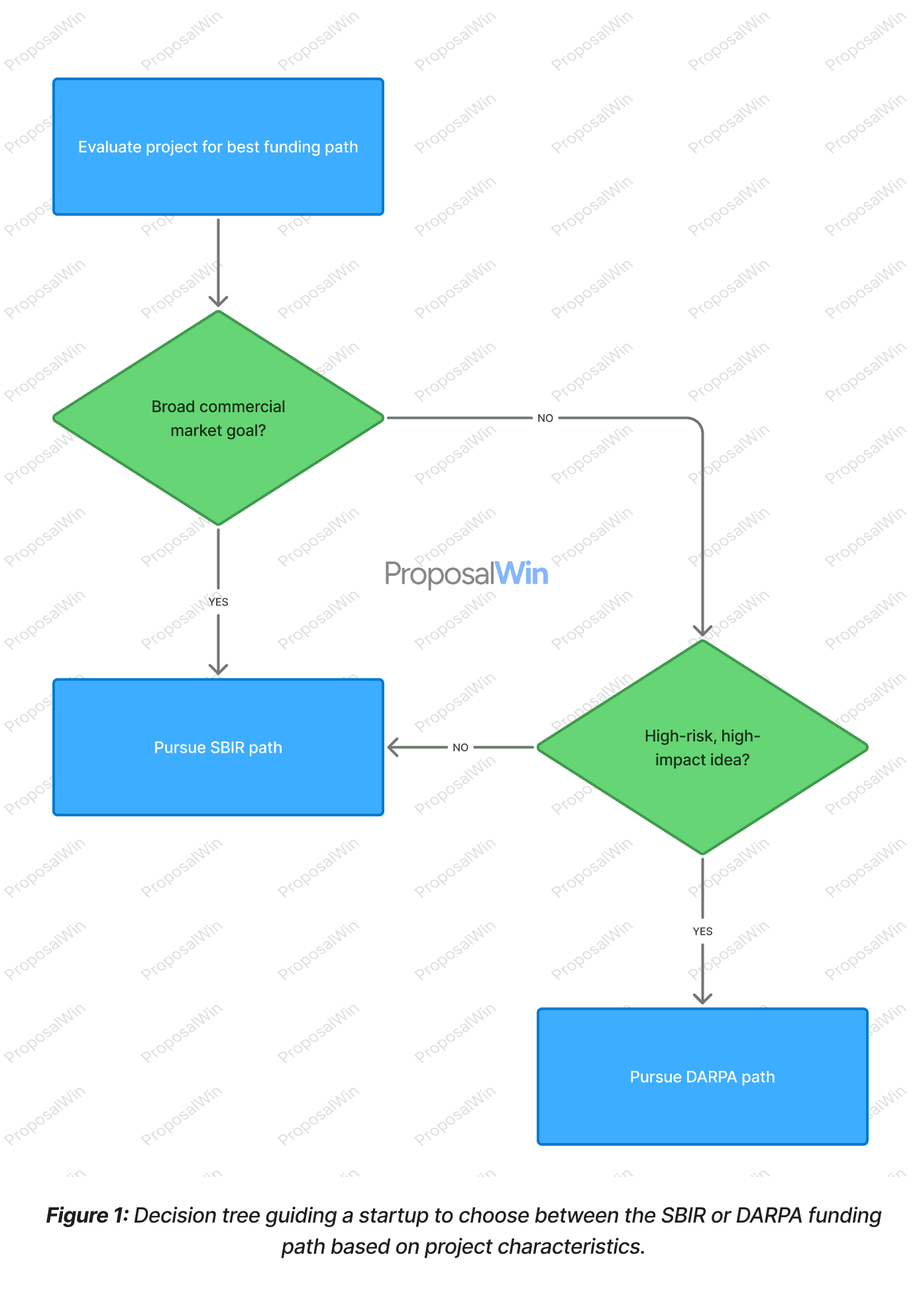
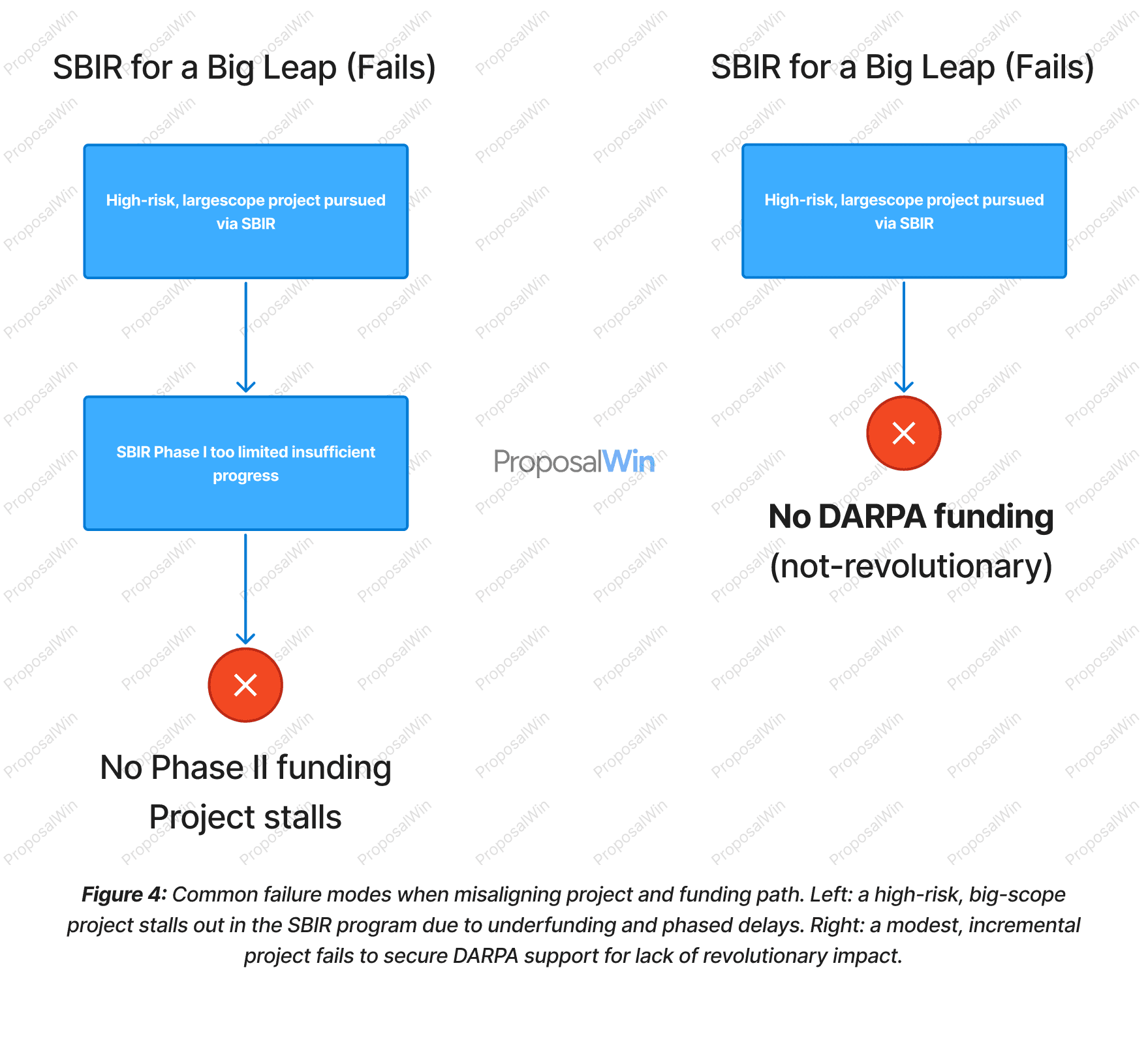
The SBIR vs. DARPA decision is not binary — the most sophisticated biotech startups pursue both in parallel, using SBIR to build foundational capabilities and credibility while cultivating DARPA relationships for transformational opportunities. However, for companies with limited resources, prioritization is essential.
Pursue SBIR first if: your technology is at TRL 2–5, you need structured milestone validation, your team lacks prior government contracting experience, or your primary market application is commercial with a government secondary market.
Pursue DARPA first if: your technology represents a genuine paradigm shift, your founding team includes recognized domain experts, you have prior relationships with DARPA PMs or BTO leadership, or your technology roadmap requires 5–10 year development horizons.
In both cases, proposal quality — not just technical merit — is the determining factor. Organizations that invest in professional proposal development consistently outperform peers with equivalent technology but weaker written submissions.
Conclusion
SBIR and DARPA represent complementary rather than competing funding paths for biotech startups. SBIR offers structured, milestone-based funding with predictable processes and lower barriers to entry. DARPA offers transformational funding potential for paradigm-shifting technologies, with higher risk and higher reward.
The most effective strategy begins with an honest assessment of where your technology sits on the readiness spectrum, what your team’s government contracting experience is, and what your organization’s risk tolerance allows. Building a multi-year federal engagement roadmap — with SBIR and DARPA as complementary instruments — positions biotech startups for durable government revenue and industry leadership.