
Introduction
In federal contracting, a common misconception is that the Government always chooses the lowest-priced offer. In reality, the acquisition regulations and practices paint a more nuanced picture — “lowest price” is often a myth rather than an absolute rule. The Federal Acquisition Regulation (FAR) emphasizes that best value, not just lowest cost, drives source selection decisions. Agencies are required to consider factors like technical quality, past performance, and risk in addition to price.
This article provides a technical examination of the federal source selection process to demonstrate why the lowest price is not always the winning factor. We will explore the procurement workflow, evaluation methods, and decision logic that contracting professionals use — supported by citations from the FAR — to dispel the myth of lowest price.
Best Value Continuum: Tradeoff vs. LPTA
The FAR introduces a “best value continuum” of source selection approaches, ranging from Lowest Price Technically Acceptable (LPTA) to tradeoff strategies. Under a tradeoff (best value) process, the government may accept a higher-priced offer if it provides superior value or quality; in contrast, under LPTA, award goes to the lowest-priced proposal that meets the minimum technical requirements.
According to FAR 15.101-2, the LPTA method is only appropriate when the Government expects no additional value from proposals exceeding the minimum requirements and can clearly define those minimum acceptability standards. In an LPTA procurement, proposals are evaluated on an acceptable/unacceptable basis for all non-price factors, and no tradeoffs are permitted.
However, Congress and the FAR have placed limits on LPTA. FAR 15.101-2(c) enumerates strict conditions for using LPTA, and contracting officers must document a justification. Moreover, FAR directs agencies to avoid LPTA for knowledge-based professional services, complex IT or engineering, or personal protective equipment — because insisting on the lowest price in such cases would deny the Government the benefits of cost-technical tradeoffs.
Additionally, FAR 15.304 reinforces that quality shall be evaluated in every source selection through one or more non-cost factors. In many cases, agencies assign higher importance to technical capability or past performance over price. This underscores that award is not automatically based on lowest price — the Government is often willing to pay more for a substantially superior proposal.
Source Selection Process: Workflow and Timeline

The federal procurement process follows a structured workflow from planning to contract award. The process begins with the agency defining its requirements and acquisition strategy — at this stage, the contracting team decides the appropriate source selection approach (tradeoff or LPTA) and contract type. Next, the solicitation (RFP) is issued. After proposals are received, evaluators review each proposal against the RFP’s stated criteria, typically assessing technical merit, past performance, and other non-price factors first. Only after determining technical acceptability do they open and evaluate prices.
Finally, the Source Selection Authority (SSA) makes a decision: choosing the lowest priced offer (if using LPTA and all minimum standards are met) or performing a best value tradeoff analysis to justify paying more for a higher-rated proposal. This decision is documented along with the rationale, including any tradeoffs of price vs. quality.
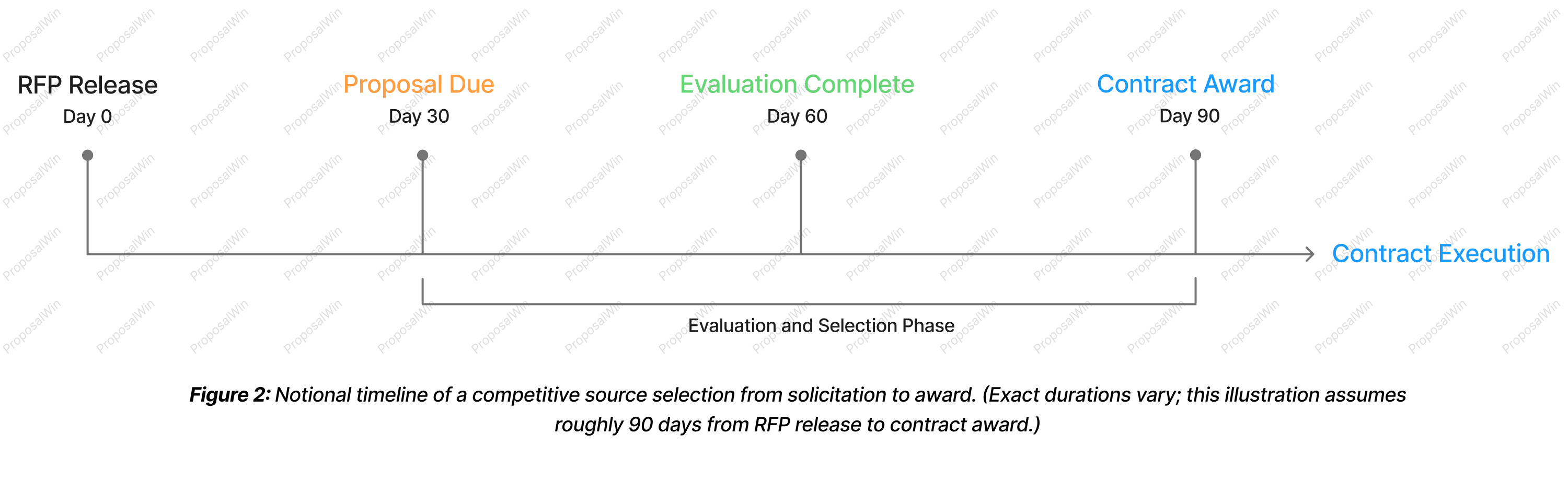
The source selection timeline can vary widely based on complexity, typically spanning several months. Even an LPTA procurement requires thorough review to ensure each offer meets all technical acceptability criteria. This timeline underscores that achieving the “lowest price” is just one part of the process — the Government must invest time evaluating quality and making sound tradeoff decisions.
Evaluation Factors and Decision Outcomes
During source selection, agencies use evaluation factors to assess each proposal. Common factors include technical capability, management approach, past performance, and price.
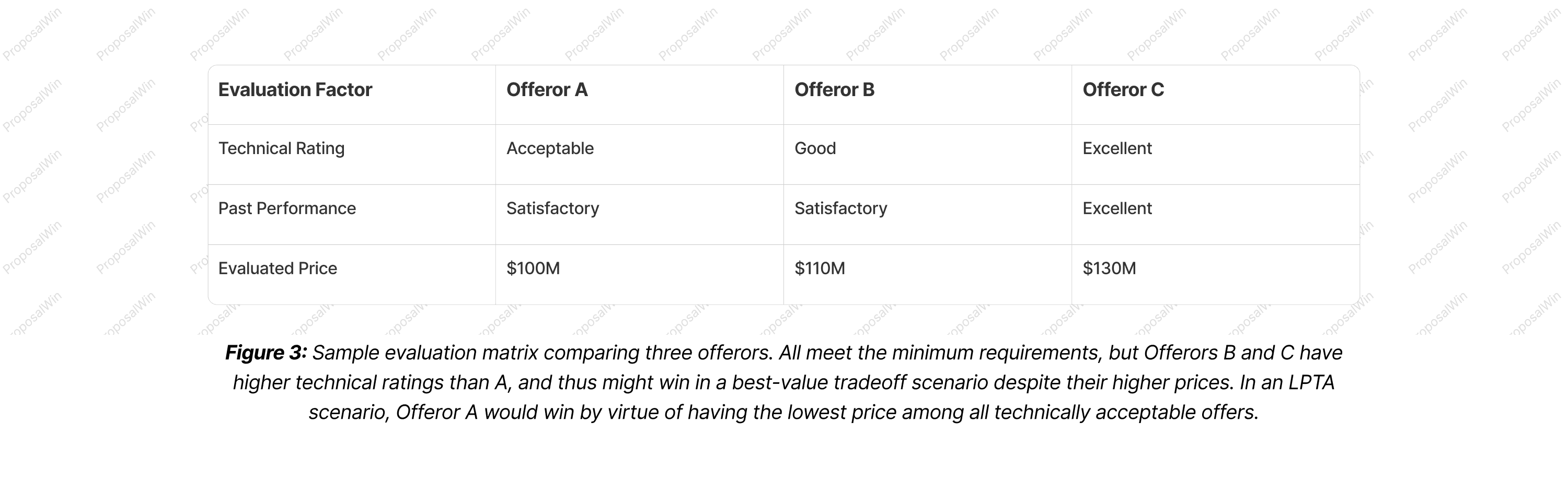
Consider a simplified evaluation matrix with three hypothetical offers. Offeror A is rated “Acceptable” technically and has the lowest price. Offerors B and C have higher technical ratings (“Good” and “Excellent”) at higher prices. In an LPTA procurement, award goes to Offeror A — once the minimum threshold is met, the lowest price wins by definition.
However, in a best-value tradeoff approach, the agency can consider whether Offeror C’s superior technical merits justify the higher price. If the technical factor was prioritized as more important than price, the SSA might determine that Offeror C’s excellent solution offers significantly higher probability of successful performance, worth the extra cost. The FAR mandates that such tradeoff decisions be documented, ensuring transparency that the decision to forego the lowest price was deliberate and justified.
Source-Selection Logic and Contract Type Considerations
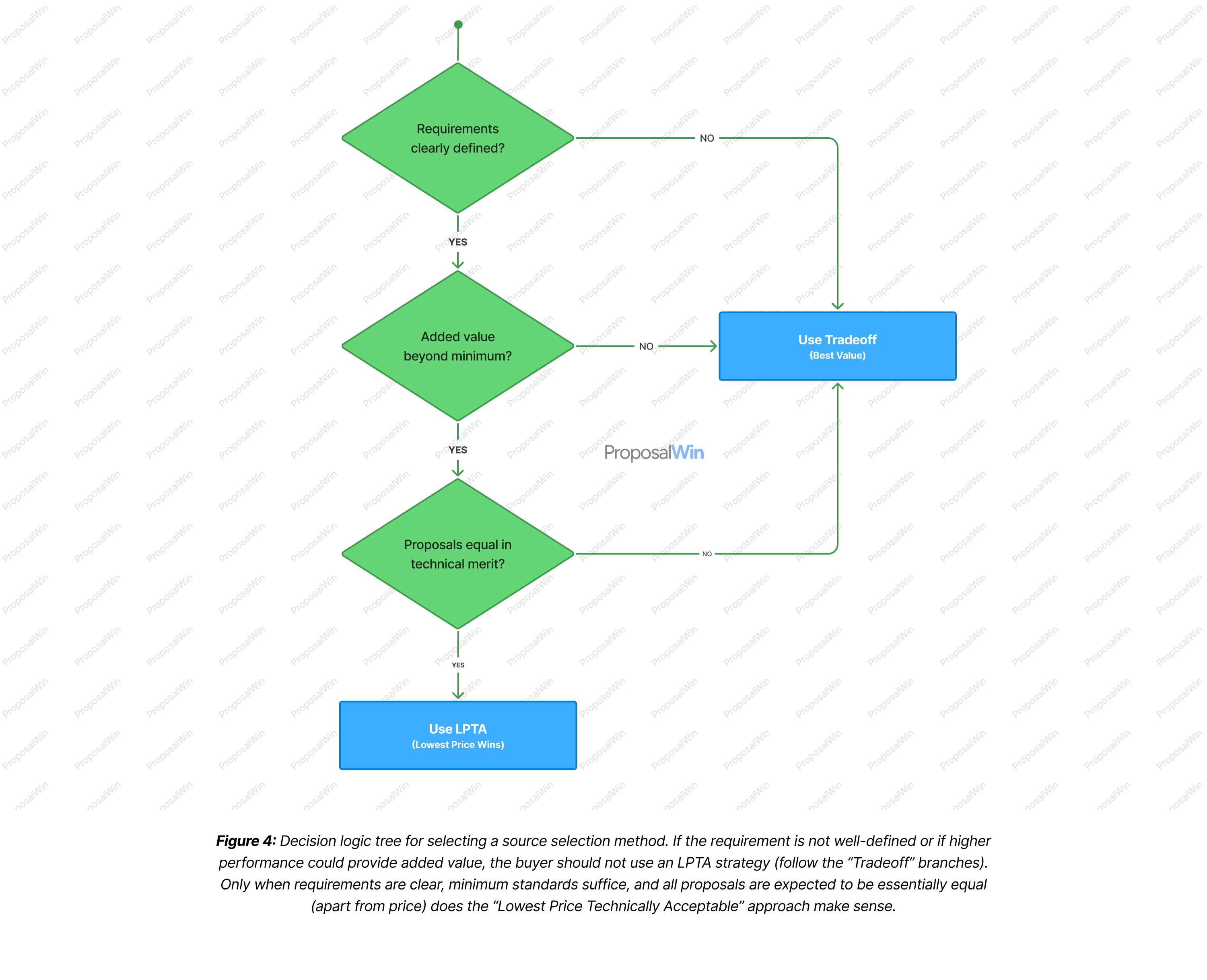
If any condition necessary for LPTA is not met — for example, if requirements aren’t crystal-clear or proposals could offer added value beyond the minimum — the buyer should pursue a best-value tradeoff. Only when the requirement is simple, well-defined, and no additional benefits would come from higher quality can LPTA be justified. Many acquisitions fail to meet these criteria, which is why the lowest-price-wins approach is far from universal.
Contract type also undercuts the “lowest price” notion. In a firm fixed-price contract, offerors commit to a total price. But in Time-and-Materials (T&M) contracts, the Government pays based on actual labor hours and materials used. A contractor might propose low hourly rates, yet if the work takes many more hours, the final price can be much higher than a competing fixed-price offer. The FAR labels T&M contracts as the “least preferred” type and allows them only when no other contract type is suitable.
Conclusion
While the allure of the lowest bid is strong, federal acquisition regulations reveal that the lowest price is often a myth when it comes to true best value. Through careful evaluation frameworks, decision logic, and appropriate contract choices, agencies strive to ensure that the selected contractor will deliver the optimal combination of price, quality, and performance. The Government frequently accepts a higher price for a better outcome, when justified.
As one industry expert observed, applying LPTA restrictions government-wide “will ensure all Federal agencies are using the best procurement approach to access innovation and obtain better results and value for the taxpayer dollar.” In the end, source selection is about best value, not just lowest price.